Western Europe has hottest June on record
June 2026 was the hottest June recorded for western Europe and the second warmest globally, driven by the highest sea surface temperatures (SSTs) on record for the month, according to the monthly update from the Copernicus Climate Change Service (C3S), implemented by the European Centre for Medium-Range Weather Forecasts (ECMWF).

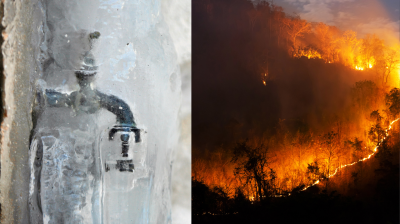
The heat in parts of Western Europe is continuing in July, fuelling devastating wildfires in France and the Iberian Peninsula.
Spain’s Fabra Observatory in Barcelona - one of WMO’s long-term weather observing stations - recorded 40.5°C on 8 July - the highest temperature in more than one century of data. France had a widespread amber alert (the second highest level) for heat as well as a high fire danger level because of drought, high temperatures and low humidity, according to Meteo-France.
WMO, its members and partners are mobilizing with early warnings and coordinated heat-health action plans to try to save lives and inform decision-making on how to minimize economic and ecosystem damage and disruption to infrastructure and labour productivity. It is accompanied by localized violent storms and in some areas by worsening drought and the risk of wildfires.
Extreme heat is expected to occur at increasing frequency and intensity and duration, according to the Intergovernmental Panel on Climate Change.
“Heatwaves like this are what we expect to see in a changing climate,” said John Kennedy, head of climate information at WMO. “In the 50 years since the historic heatwave in 1976, Europe as a whole has warmed by around two degrees. It’s the fastest warming continents and extremes of temperature have increased too,” he said.
Land and marine heatwaves
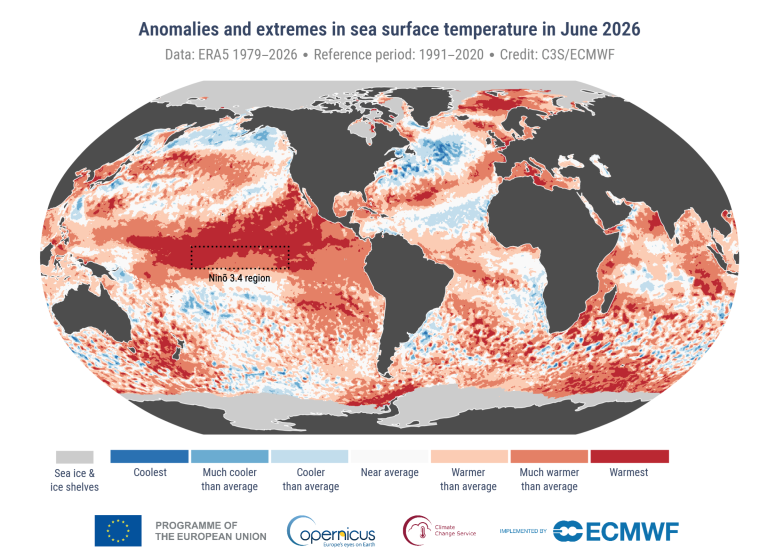
June saw much of western Europe experiencing a record-breaking heatwave and marine heatwaves across the western Mediterranean and along the Atlantic coasts.
Globally, the monthly average sea-surface temperature for the extra-polar ocean (60°S–60°N) was the highest for June, exceeding the previous record set in June 2024 by just 0.01ºC. This partly reflected the development of strong El Niño conditions in the equatorial Pacific, according to Copernicus Climate Change Service.
The heatwave broke monthly and all-time temperature records across several European countries and contributed to severe health impacts, including heat-related deaths.
Europe also saw widespread dryness that, together with extreme heat, contributed to wildfire activity, particularly in the Iberian Peninsula and southern France, and heightened drought risk in parts of eastern Europe. The June heatwave occurred against a backdrop of increasingly dry soils across western and central Europe, further exacerbating drought conditions that had begun to develop during May's heatwave.
Globally June 2026 was the second-warmest in the ERA5 dataset, with an average surface air temperature of 16.54°C, 0.56°C above the 1991-2020 average for the month, behind June 2024.
The average temperature over European land in June 2026 was the second-highest on record for the month. Western Europe, the region most affected by the heatwave, experienced its warmest June on record, with an average temperature of 20.74°C, 3.05°C above the 1991–2020 average for June, surpassing the previous record set in June 2025.
Snapshot of June records
The WMO Secretariat is compiling a regularly updated snapshot of temperature records. This is not a fully exhaustive list and some of the figures are provisional. It is intended as a guide to help in media reporting and to provide information on the scale of the extreme heat.
Germany broke new temperature records for three consecutive days, with the town of Coschen in eastern Germany near the border with Poland reporting 41.7°C on 28 June. A total 252 weather stations recorded all time temperature records – the highest ever. According to DWD, 46 stations throughout Germany recorded temperatures of above (40°C) -until 27 June.
Overnight temperature records also tumbled. A weather station in East Saxony reported an overnight minimum temperature of 29.4 °C. DWD termed the heatwave as “historic.”
Hungary: A new June temperature record of 40.7°C was recorded near the capital Budapest on 28 June, with heat forecast to intensify further. Poland also recorded a new all-time temperature record, provisionally of 40.5°C, as did the Czech Republic.
Austria set a new June temperature record of 40.0 °C in the Vienna City, with a Red Alert continuing for the capital on 29 June, according to Geosphere Austria.
The United Kingdom broke the June temperature record for three consecutive days, with 37.3 °C recorded in southern England on 25 June – a provisional figure which was likely to be revised upwards. The UK’s Met Office issued Red Warnings for Extreme Heat once again for 26 June – the first time in the history of the current weather warnings system that red warnings have been issued for three straight days.
This comes just weeks after May also saw UK daily temperature records broken.
In the Netherlands, the Dutch national meteorological service, KNMI, issued an unprecedented Red Alert for extreme heat for eight provinces for 26 June for 26 June, and reported a number of new station records, and a new national June temperature record of 39.4 °C.
Denmark set a new all time high temperature of 37.0 °C in two locations, breaking a record set in 1975, according to the Danish Meteorological Institute.
Switzerland set a new June temperature record of 39°C in the northern city of Basel, according to Meteo-Suisse.
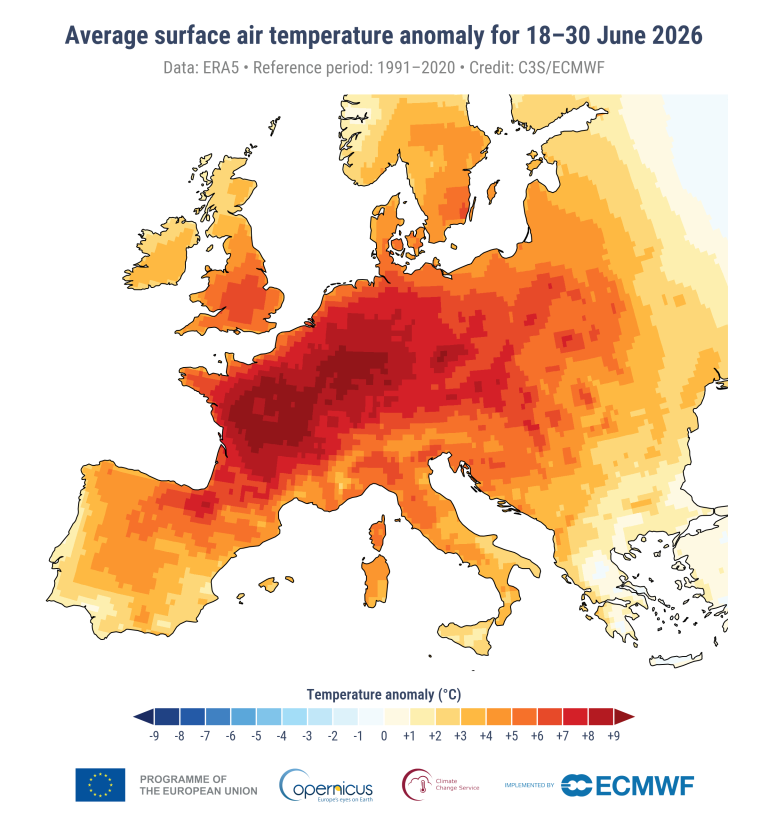
France: France recorded its hottest day on record on 24 June - beating the record set the previous day - with an average national temperature of 30.0° Celsius, above previous records set in July 2019 and August 2003, said Metéo-France. Temperatures rose up to 43.8 °C in the town of Pulluau in western France. Overnight temperatures also set a new national record of 22 °C.
A top-level Red Alert was issued for a record 58 departments - most of the country. Authorities warned of a high risk of wildfires amid a worsening drought. Underlining the associated dangers with the life-threatening heat, 40 people reportedly died in drowning accidents in France.
Spain recorded its hottest June days on record on 23 and 24 June. In a number of locations, temperatures were well above 40°C, setting many new June station temperature records, according to the Agencia Estatal de Meteorologia, AEMET. The city of Bilbao reached 42.7°C, the highest June temperature recorded there.
Health Impacts
Extreme heat of often called the “silent killer” and in many countries it is underreported. There were approximately 489,000 heat-related deaths annually between 2000 and 2019, according to modeled estimates.
Heat stress occurs when the body gains more heat than it can release. Under normal conditions, the body manages its temperature through sweating and increased blood flow to the skin. But when the surrounding air is hot -especially when it is also humid- these cooling mechanisms struggle to keep up, and core body temperature begins to rise.
“Prolonged exposure over several days, particularly when temperatures remain high at night, means the body enters each new day already stressed. Older adults, young children, pregnant women, outdoor workers and people unhoused or living with chronic illness are among those most at risk, but heat stress can affect anyone when temperatures are extreme enough for long enough,” says Lachlan McIver, Health Advisor, WHO-WMO Climate and Health Joint Office.
It’s not just daytime temperatures, but also overnight minimum temperatures. A “tropical night” is a term widely adopted in some regions such as Europe and parts of Asia. It can be defined as a night where the temperature does not drop below 20°C (68°F). During heatwaves, these become increasingly common, particularly in cities.
Night time is when the body is supposed to recover. When we sleep, our core temperature drops, our cardiovascular system rests, and the cumulative stress of a hot day begins to ease. When nights stay warm, that recovery does not happen. The body remains under strain around the clock, explains Armel Castellan, Extreme Heat Services Technical Advisor of the WHO-WMO Climate and Health Joint Office.
“This is why, when assessing the health impact of a heatwave, minimum temperatures can be more telling than the peak afternoon high. A day that reaches 38°C but drops to 18°C overnight is very different from a day that reaches 36°C and stays above 25°C through the night. The second scenario carries a much higher health risk,” he says.
During a heatwave, the urban heat island effect adds several degrees to the felt-like temperature, amplifying already present risk. A regional temperature of 35°C can translate to 38 or even 40°C on a dense city street with no shade or green spaces, and nights that might otherwise offer some relief stay warmer than surrounding areas.
WMO Response
The extreme heat set the backdrop for a special address by UN Secretary-General António Guterres at London Climate Week on 23 June.
“We have just lived through the eleven hottest years ever recorded. Climate disasters are becoming more frequent, more destructive, and more costly. And the World Meteorological Organization has warned we ain’t seen nothing yet. El Niño is not just knocking on the door. It risks blowing the house down. Turning up the heat. Disrupting food and water systems. And hitting the vulnerable the hardest,” Mr Guterres said.
WMO’s El Niño Update issued at the start of June forecast that a rapidly developing El Niño will affect weather and climate patterns in the coming months. Impacts are typically greater in other parts of the world than in Europe.
WMO is one of ten specialized United Nations entities supporting the United Nations Secretary-General's Call to Action on Extreme Heat. The initiative seeks to strengthen international cooperation and reduce heat impacts through improved science, early warning systems, public awareness and coordinated action.
Through the Early Warnings for All initiative, WMO and its Members are working to ensure that people at risk receive timely warnings and information on protective actions before dangerous heat occurs.
WMO and the World Health Organization (WHO) have jointly developed guidance on extreme heat and heat-health early warning systems. These systems and tools support Heat Action Plans and strengthen frameworks for extreme heat governance, helping governments, health authorities and communities prepare for and respond to extreme heat events. The WHO-WMO Climate and Health Joint Programme works to ensure that climate, weather and environmental information is accessible, timely and actionable for public health decision-making.
Through the Global Heat Health Information Network (GHHIN), WMO and other UN Partners are leading efforts to strengthen governance for extreme heat by providing national authorities and local governments with the technical guidance and concrete tools needed to prepare for and respond to this growing risk.